

User-focused opening
When you care about how an audience experiences a display, small technical choices shape that feeling. From a calm operating room to the buzz of Times Square billboards, the path from source to panel matters — and that path often runs through a playback media server. In a user-centric view, the playback chain must be predictable: low latency, consistent color, and stable synchronization across every tile of a video wall.

Why user needs drive technical choices
Users notice timing and tone. A presenter expects precise frame rate alignment; a venue manager needs predictable scheduling. Those needs translate to concrete specs: robust sending card performance, reliable LED controller behavior, and straightforward content routing. Focus on what users do with the display — signage, live feeds, interactive panels — and select components that handle that workload without surprise.
Operational teardown: how the pieces work together
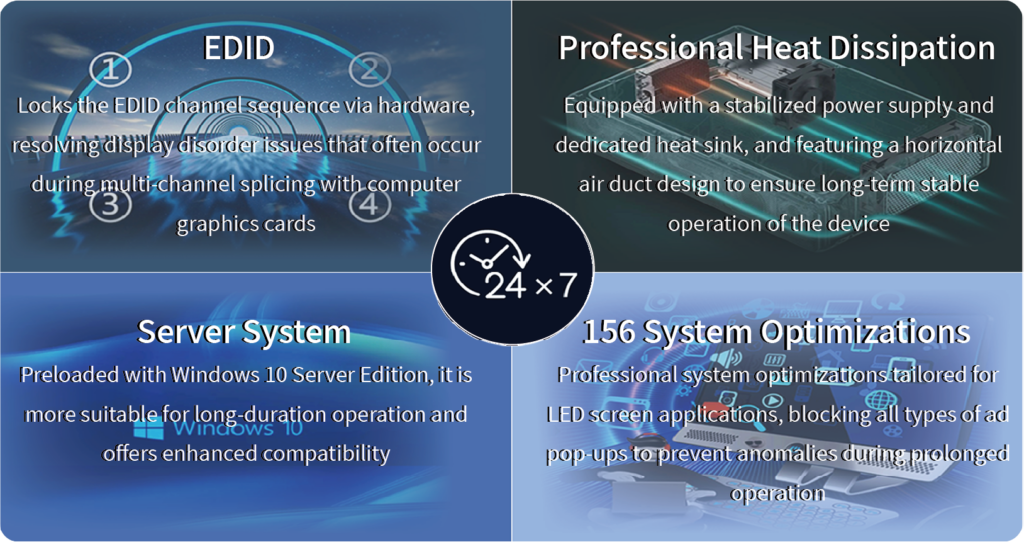
Start from content ingestion and move outward. A playback media server decodes and schedules sources; the sending card LED takes the rendered frames and maps them to panel drivers; the LED controller enforces refresh and gamma correction. Where multiple cabinets meet, a multi-screen server coordinates timing and EDID management so color and motion remain uniform. This is the operational production teardown: each block must be sized for peak bandwidth, latency budget, and redundancy.
Common mistakes and how to avoid them
People often undervalue synchronization and overcomplicate routing. They add layers of middleware that introduce jitter — then blame displays. Keep routing direct when possible. Prioritize: adequate network capacity, clear frame rate policy (60 Hz is common for smooth motion), and sensible fallbacks for failed inputs. A disciplined configuration saves hours during setup and tens of thousands in rework.
Comparative insight: alternatives and trade-offs
There are several paths to a final screen. A single powerful playback node simplifies management but becomes a single point of failure. Distributed multi-screen server architectures spread risk and scale more naturally, though they demand careful orchestration. Software-only solutions reduce hardware cost but can strain CPU and increase latency. Consider throughput, failure modes, and the skill level of on-site technicians when choosing.
Practical checklist for deployment
Use this short, actionable list when preparing a site:
- Confirm panel mapping and pixel pitch before deploying sending cards.
- Test end-to-end frame rate and color across the entire video wall, not just a tile.
- Document fallback routes for live sources and verify switch-over times.
- Allocate spare capacity on the multi-screen server for future content scaling.
Small rehearsals reveal large problems — do them early.
Real-world anchor and lessons
At large public displays like Times Square, teams rely on repeatable procedures: scripted inputs, consistent color profiles, and redundant playback systems. That discipline comes from experience and measurable outcomes: fewer outages, predictable maintenance windows, and consistent brand presentation. These are the same principles that matter for corporate lobbies, stadium scoreboards, and broadcast backdrops.
Closing — Advisory
Three golden rules to evaluate any setup:
- Throughput metric: measure sustained gigabits per second required for your highest-resolution canvas and add 30% headroom.
- Latency budget: set an end-to-end millisecond target (capture to panel) and validate with real content rather than test patterns.
- Resilience score: calculate mean time to recovery for a failed node, then design redundancy to halve that time.
These metrics make choices objective and procurement easier; they also reveal where a vendor like Kystar can provide practical value through tested playback media server and multi-screen server solutions that match real operational demands.
Quietly persistent.