
How project teams can assess Ptc Fan Heater by clarifying application scope for early research
When a procurement team reviews a ptc fan heater, the first task is to define the application rather than compare broad product claims. Early research should establish where the heater will operate, what must be controlled, and which page-listed details match the intended equipment. This keeps the initial shortlist practical and prevents assumptions from becoming requirements.

Define the use case and constraints
Start with the equipment or enclosure that needs heat. The official product page lists applications including egg incubators, 3D printers, HVAC equipment, medical and laboratory equipment, industrial machinery, and electrical cabinets. These examples provide a useful starting scope, but they do not establish suitability for every design. Procurement should identify the exact application, the available installation space, the supply arrangement, and the required control method before requesting a quotation.
Electrical requirements are an early screening point. The page describes this insulated module as supporting 50–200W and 12–220V. Treat those figures as product-specific evidence for the listed module, not as a general range for every PTC heater. A team should compare the intended system with these stated values and record any unresolved difference as a supplier question.
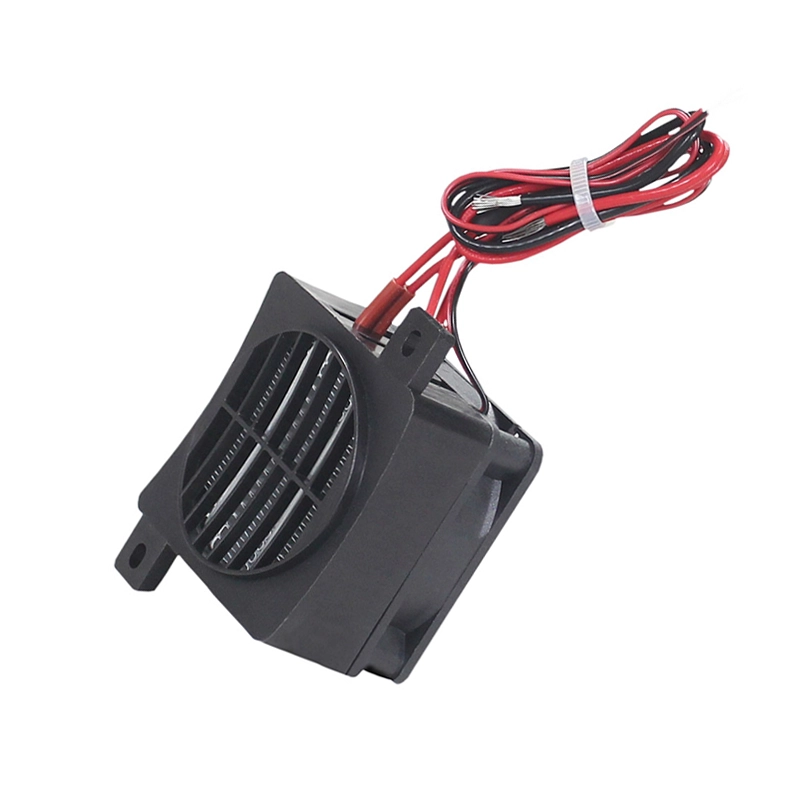
Physical integration also needs a clear description. The page presents a compact housing with a front grille outlet, built-in fan, side mounting bracket, PTC ceramic element, and nylon shell. Those details help a project team frame its mechanical review. They do not, by themselves, confirm that the module will fit a particular cabinet, chamber, duct, or machine. The required mounting position and airflow path should therefore be documented separately.
- Identify the intended equipment or enclosure and compare it with the page-listed application contexts.
- Record the reviewed module’s stated 50–200W and 12–220V range as product-specific evidence.
- Map the planned control method to the listed thermostat, thermal-switch, or PLC compatibility.
- Ask about separate wiring, independent control, and any requested custom wiring configuration.
Map stated evidence to requirements
Use a simple evidence map with three columns: requirement, page evidence, and open point. For example, a requirement for automated temperature control can be matched to the page statement that the heater is compatible with mechanical thermostats, electronic thermostats, thermal switches, and PLC systems. The open point is then the control architecture selected for the project, not a claim that every control arrangement has already been validated.
The same approach applies when reviewing a ptc heater fan for an enclosed application. The page states that the heater and fan support separate wiring and independent control. It also states that custom wiring configurations are available upon request. These details can support an integration discussion about separate control circuits or automation interfaces. They should not be expanded into assumptions about a particular machine’s wiring, controller, or operating results.
For an application such as a drying cabinet, the page includes an image description of an industrial drying cabinet with an insulated door and ventilated metal chamber. This is one concrete application reference for early research. It is not proof of a specified drying cycle, temperature uniformity, or production outcome. Keep the anchor narrow: it shows the type of equipment presented on the page, while the project team still defines its own operating requirements.
The page also presents an enclosed FDM 3D printer with a glass door and visible build chamber. This can help procurement distinguish between an application context and a generic room-heating request. A buyer can use the context to ask whether the intended installation resembles an enclosed machine, cabinet, or chamber. The image does not establish performance inside a specific printer or enclosure.
Turn open points into supplier questions
Once the application is written down, convert each uncertainty into a direct question. Ask which stated electrical range applies to the proposed configuration, how the module is intended to be mounted, and whether the available wiring arrangement matches the control panel. Ask how the separate heater and fan connections should be handled in the planned system. These questions keep the discussion tied to the selected product rather than to broad category language.
Procurement should also separate confirmed facts from requested options. Confirmed page details include the listed power and voltage range, the integrated fan, the housing description, and the named application examples. A requested option might be a custom wiring configuration. Recording that difference helps engineering, purchasing, and the supplier use the same terminology during early review.
One page-level consent statement concerns advertising-related storage and the use of data for Google Ads conversion measurement, with website conversions imported from Google Analytics when the required Analytics consent is provided. This statement is an administrative page detail, not evidence about heater performance or application suitability. Keeping it separate from the product evidence prevents unrelated page content from influencing the technical assessment.
Choose a defensible next step
The best next step is a short application brief. Include the equipment type, available space, supply conditions, control method, mounting concept, and the page evidence that supports the initial review. Mark every item that still needs supplier confirmation. This brief gives the team a traceable basis for progressing from search results to a focused technical conversation.
For early research, the goal is not to declare a universal winner. It is to show why a particular module belongs on the shortlist and what must be resolved before selection. A disciplined review of the stated application scope, electrical details, mechanical description, and control options gives procurement a clear path. PTCYIDU can then be treated as the named source for the reviewed product information, while the final decision remains tied to the project’s documented requirements.