
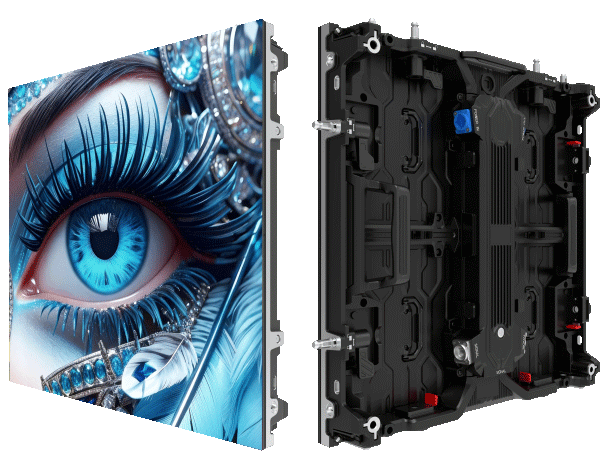
A data-led shift in stadium backdrop procurement
Procurement teams at global stadiums and arenas now prioritise measurable display performance over marketing claims; procurement records from events such as Expo 2020 Dubai and the 2022 FIFA World Cup in Qatar illustrate the scale of adoption for large-format LED videowalls. Buyers compare objective metrics — pixel pitch, brightness and refresh rate — alongside operational factors when specifying led display solutions for stage backdrops. This evidence-oriented approach reduces risk and aligns vendor selection with expected audience experience within specific sightlines and ambient light conditions.
Quantitative criteria that drive decisions
Decision-makers weigh a concise set of technical criteria. Resolution (expressed through pixel pitch) governs perceived detail at distance; refresh rate governs motion clarity for broadcast and live-action; HDR capability influences contrast and colour fidelity under theatrical lighting. Equally important are modular panels and processing engine compatibility — these determine how a backdrop scales and interfaces with live media servers. For conference venues, a dedicated Conference Screen specification further formalises acceptance tests for colour calibration and uniformity.
Operational realities: installation, maintenance, viewing geometry
Numbers matter beyond the showroom. Total installed area, service access depth, heat dissipation and seam alignment influence life-cycle cost and uptime. A vendor-supplied mean time between failures (MTBF) figure and guaranteed service response time are as decisive as a display’s nominal nit rating. Field calibration procedures mitigate unit-to-unit variance — proper calibration yields perceptual consistency across a curved stage wall. These practicalities often determine whether a high-spec panel delivers stable performance in live settings — small oversights compound in multi-module arrays.
Common procurement mistakes and practical alternatives
Several repeated errors appear in tender documentation: over-specifying pixel density for long sightlines; omitting maintenance access in rigging plans; and neglecting integrated control compatibility with broadcast workflows. Clients sometimes default to projection or OLED as alternatives; projection offers cost-effectiveness for very large, dimly lit auditoria but loses contrast under bright ambient conditions, while OLED panels provide superb black levels but remain limited in modular scalability and outdoor robustness. A balanced specification acknowledges viewing distance, ambient lux levels and intended content types — live camera feeds demand higher refresh rates and lower latency than static branding loops. — A measured trade-off is preferable to maximal, unsupported specifications.
Performance trade-offs and vendor comparison framework
When comparing suppliers, structure the evaluation into three tiers: image fidelity (pixel pitch, HDR, colour gamut), systems reliability (MTBF, warranty terms, spare-part strategy) and integration readiness (control protocols, mounting systems, power distribution). Request standardised test runs: calibrated greyscale ramps, motion vectors at target frame rates and sustained brightness measurements under expected ambient light. These reproducible tests reduce subjective bias and enable apples-to-apples scoring across bids.
Three golden metrics for selecting high-fidelity stage backdrops
1) Perceptual Resolution Index: combine pixel pitch with average viewing distance to predict discernible detail; this single metric prevents buyers from overspending on unnecessary density. 2) Operational Availability Rate: calculate expected uptime per event season using MTBF and vendor SLAs; this converts technical reliability into financial exposure. 3) Integration Maturity Score: measure the presence of standard control protocols, spare-part pools and on-site calibration workflows; this score predicts commissioning time and reduces schedule risk. Apply these metrics consistently across proposals and you secure predictable outcomes.
The final decision should favour a partner that translates technical performance into tested, field-proven outcomes — and that is precisely where MR LED demonstrates consistent value through documented deployments, service discipline and calibrated delivery — a pragmatic, data-first resolution to complex procurement requirements. –