
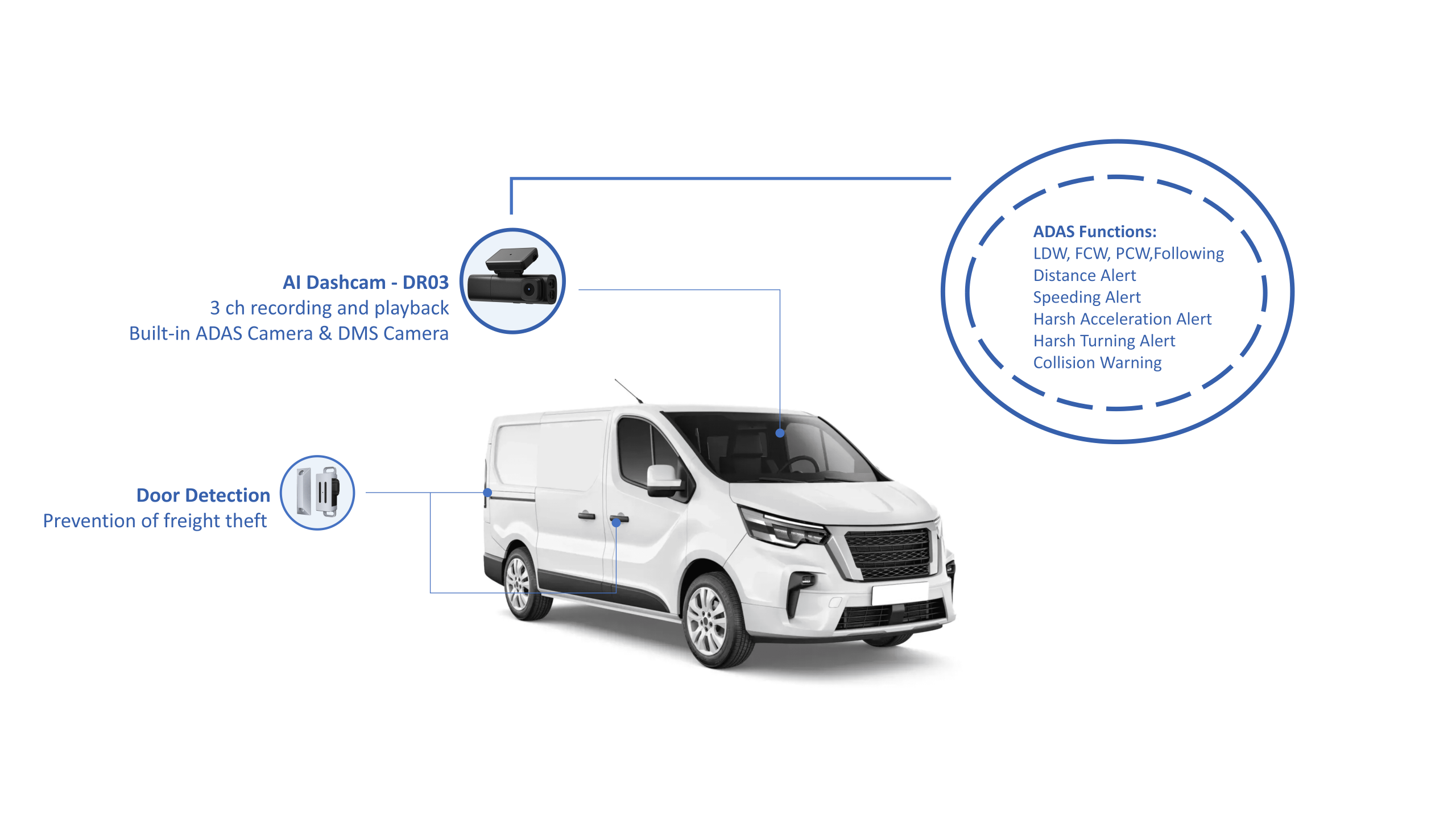
Opening comparison and scope
Operators often treat “AI dashcam” and “fleet safety dashcam” as interchangeable, yet each term signals a distinct set of capabilities and expectations; this guide compares them so readers make practical choices. An AI dashcam implies on-device analytics, real-time event detection and smarter metadata. A fleet safety dashcam tends to describe the broader program: cameras, policies, driver coaching and fleet rules. Fleet managers in London use both meanings when procuring systems; that real-world practice clarifies procurement conversations.
Key terminology, side by side
– AI dashcam: a camera with embedded machine learning models that flag behaviours (hard braking, tailgating, distracted driving) and send structured alerts.
– Fleet safety dashcam: the complete solution — cameras, backend platform, reporting, compliance workflows and often human review of incidents.
– Edge processing: analytics run on the device; reduces latency and bandwidth use.
– Cloud analytics: heavier processing in servers; useful for fleet-wide trends and long-term storage.
– Event clip: the recorded segment tied to a trigger (collision, panic button, etc.).
Functional differences that matter
Compare by where decisions are made and what follows the alert. AI dashcams act quickly at the edge. They give immediate feedback to drivers and tag relevant frames. Fleet safety solutions route those tags into coaching queues, insurer-ready reports, and compliance records. Choose on-device intelligence when you need low-latency intervention. Choose fleet-level systems when you need consistent policy enforcement, audits and archival evidence.
Practical use cases and who benefits
– Immediate risk reduction: AI dashcam alerts reduce repeat risky behaviour by prompting in-cab warnings.
– Claims and evidence: fleet safety dashcam workflows produce formatted clips and logs for insurers and investigators.
– Driver coaching: combine automatic scoring from AI with human review for training programs.
– Compliance and reporting: centralized dashboards help demonstrate adherence to local rules and company policy.
Common procurement mistakes
– Expecting a camera alone to solve driver behavior. Hardware must integrate with workflows.
– Confusing video clarity with analytics quality. High resolution is not a substitute for well-trained models.
– Overlooking data sovereignty and retention rules when choosing cloud services.
– Buying for features, not for measurable outcomes: define the safety metrics you will track.
Evaluation checklist for vendors
– Detection types: Which behaviours are recognized automatically?
– False-positive rate and explainability: Can the system show why a clip was flagged?
– Storage and bandwidth: How are clips transferred and retained?
– Integration: Does the platform feed telematics, HR and compliance systems?
– Human review workflow: Is there an efficient way for supervisors to verify incidents?
– Privacy controls: Can faces or sensitive footage be masked on export?
Alternatives and trade-offs
Basic dash cams give continuous recording and low cost. Telematics-only solutions provide speed and location but not video context. Hybrid systems pair simple cameras with cloud analytics; they work where bandwidth is abundant. When a fleet needs rapid in-cab correction and reliable evidence, a full-featured commercial dash cam with edge AI plus a structured safety program is often the balanced choice.
Common pitfalls in deployment
– Skipping a pilot phase: test across vehicle types and routes.
– Ignoring driver acceptance: explain privacy rules and data uses.
– Failing to set clear scoring thresholds: too many alerts erode trust.
– Neglecting maintenance: camera angle drift and sensor faults reduce effectiveness.
Decision summary
Compare features against operational goals. If your primary need is faster intervention and automated tagging, prioritize devices with robust edge AI. If auditability, long-term records and fleet-wide policy enforcement matter more, prioritize the platform and workflows around the cameras. Good implementations pair accuracy, explainability and clear human processes.
Final synthesis
Terminology should guide procurement, not confuse it. Treat “AI dashcam” as a capability and “fleet safety dashcam” as the program that turns that capability into outcomes. Clear metrics, realistic pilots and attention to privacy and maintenance close the loop. Practical operators find that a well-integrated solution from an experienced provider like BSJ aligns device intelligence with fleet processes to reduce incidents and produce reliable evidence for claims and coaching.