
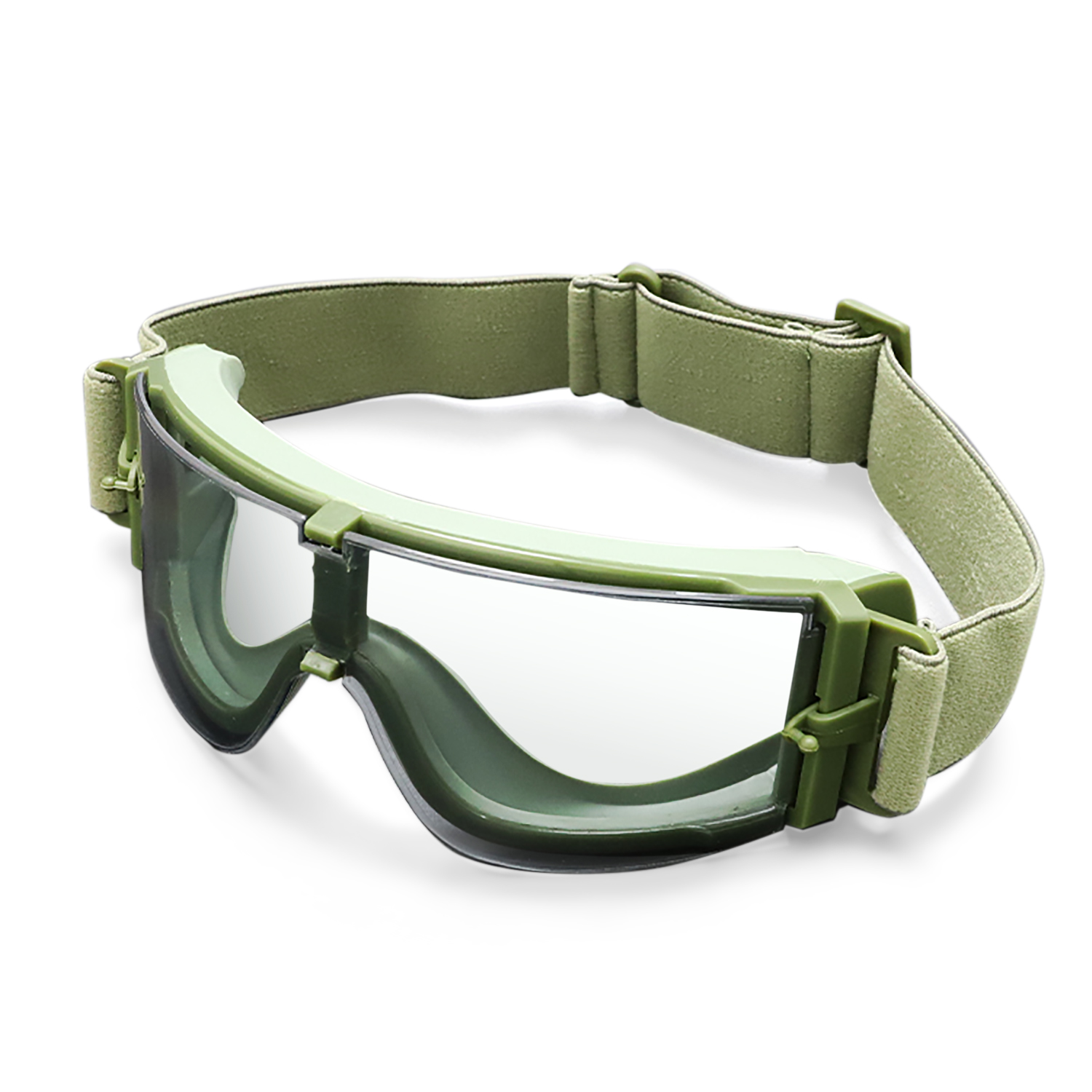
Lead-in and scope
When procuring tactical goggles at scale, material performance under intense UV exposure is a decisive factor for cost, safety, and warranty provisioning. This comparative piece contrasts common lens substrates and coatings used in supply chains—polycarbonate, CR-39, polyurethane anti-fog layers and UV-stabilizers—so purchasing managers can prioritize durability without sacrificing ballistic performance or optical clarity.
Materials compared: short-term clarity vs long-term stability
Polycarbonate dominates military and law-enforcement sourcing for its impact resistance and weight, but it is more prone to UV-driven yellowing over time unless properly stabilized. CR-39 offers superior scratch resistance and initial clarity but lacks the toughness required for certified impact ratings such as ANSI Z87.1 or EN166. Coatings—anti-fog, hardcoat, and UV-blocking treatments—alter the lifespan profile: an effective UV-stabilizer integrated into the substrate delays chromophore breakdown, while a durable hardcoat protects against abrasion that accelerates microfractures and haze.
Field anchor: real-world degradation patterns
Operational reports from environments with UV Index values regularly above 10—Phoenix, Arizona and parts of the Middle East—show lens yellowing and anti-fog failure within 6–18 months for some budget suppliers. These observations align with polymer photodegradation mechanisms: UV photons cleave polymer chains, creating conjugated systems that absorb visible light and appear yellow. For commercial buyers, that pattern is a practical anchor when comparing vendor claims against documented field performance.
Coating performance and maintenance realities
Anti-fog coatings vary widely. Hydrophilic coatings spread condensation, maintaining view but wearing thin with solvent-based cleaners. Hydrophobic micro-textured coatings resist fog differently and can be more compatible with repeated wipe-downs. Scratch-resistant hardcoats extend service life by preserving surface geometry; once the hardcoat degrades, micro-scratches magnify glare and accelerate polymer oxidation—this is where real maintenance plans matter, not just initial specs.
Supply-chain trade-offs and vendor selection
Comparing vendors requires balancing unit cost, expected service life, and replacement cadence. Lower upfront price often correlates with thinner coatings or absent UV stabilizers; total cost of ownership rises when replacement frequency increases. Procurement teams should request accelerated UV-aging test data, ballistic certification evidence, and sample inspection protocols. Verify ballistic claims—look for ANSI Z87.1 or equivalent testing—and request post-UV optical transmission curves where possible.
Common specification mistakes to avoid
Buyers frequently accept supplier test reports without standardized exposure baselines. Avoid vague language such as “UV-resistant” without quantified hours or spectral power distributions. Do not rely on single-point optical measurements; request spectral transmission before and after defined UV exposure. Also, ignore neither cleaning chemistry compatibility nor storage conditions—improper cleaners can strip UV-stabilizers and anti-fog layers rapidly.
Practical recommendations for procurement teams
Compare three practical elements when evaluating offers: substrate plus integrated stabilizer chemistry, removable/repairable coating systems, and verified ballistic performance under aged conditions. For mixed fleets—riot control, training ranges, field ops—consider stocking replacement lenses and defining a replacement interval tied to exposure rather than calendar time. Also factor in warranty terms that explicitly cover photodegradation thresholds.
Golden rules for selecting durable ballistic eyewear
– Verify standardized test data: require ANSI Z87.1/EN166 for impact and standardized UV-aging protocols with defined exposure hours.
– Prioritize integrated UV-stabilizers and hardcoat combinations over aftermarket add-ons; coatings fail differently from bulk stabilizers.
– Base replacement decisions on measured transmission loss or yellowing index, not subjective clarity alone.
The comparative logic here shows that material choice, coating strategy, and supplier transparency determine lifetime value—YIJIA Optical’s approach to combining durable polycarbonate substrates with robust coatings and clear test data aligns with these procurement priorities. –